2.1.0 Instruments
The library holds 164 instruments and the performance file that turns them into an arrangement. This section covers what is in it and how the Browse page organises it. SECTION 2.2 CONTROLS then covers playing one instrument on its own, and SECTION 2.3 SCORING ENGINE covers the engine.
A Loading the Scoring Engine or an Instrument
The Browse page button in the Navigation Bar opens with the Installed tab selected by default. Select EW Hollywood Scoring Tools from the Installed column to view its contents, and decide whether to load the Scoring Engine or individual instruments, both of which use the same sound library.
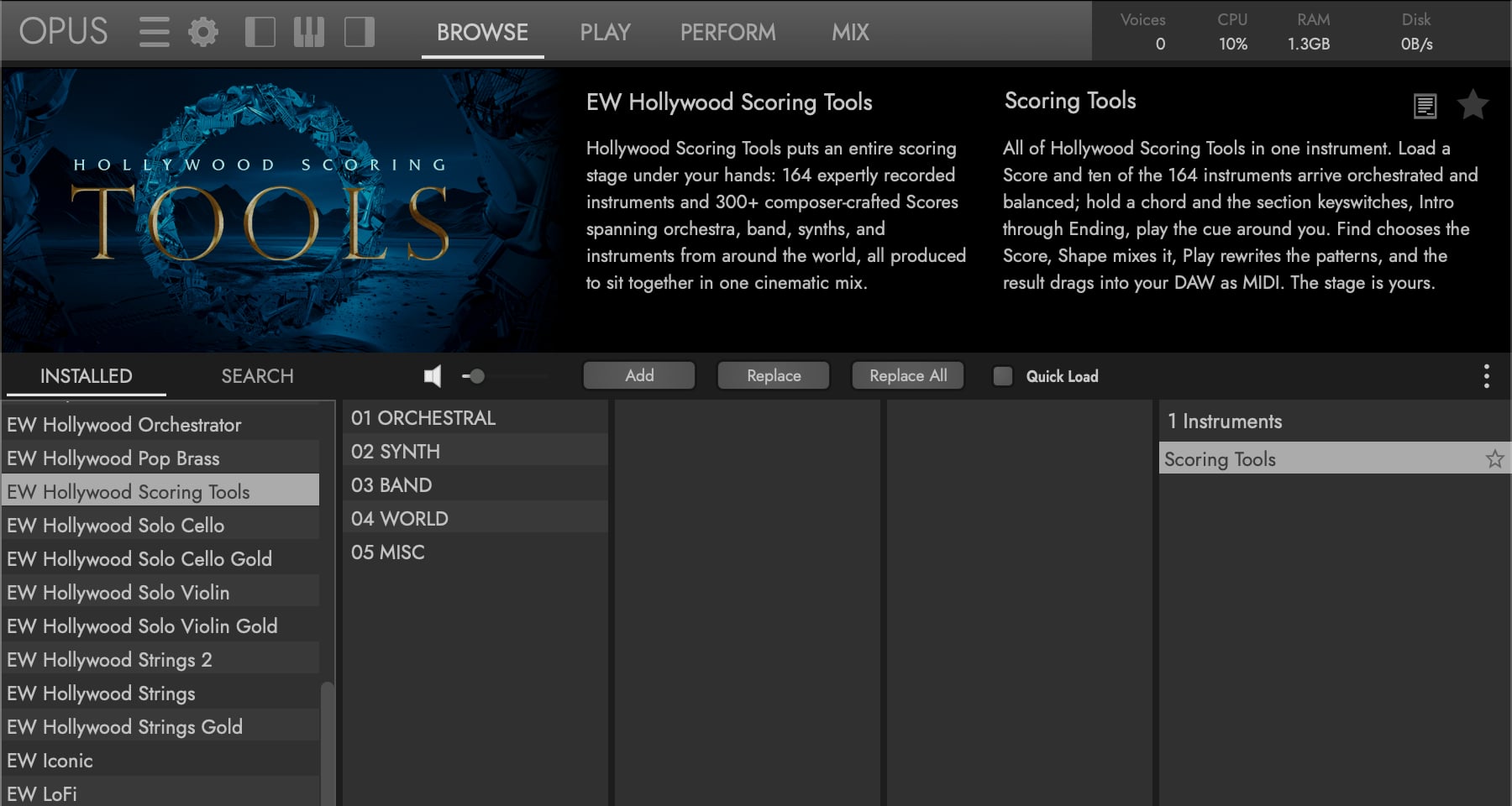
Scoring Tools is the performance file that launches the Scoring Engine. It sits at the library’s top level, outside the five categories, and opens on the Opus Perform page. See SECTION 2.3 SCORING ENGINE.
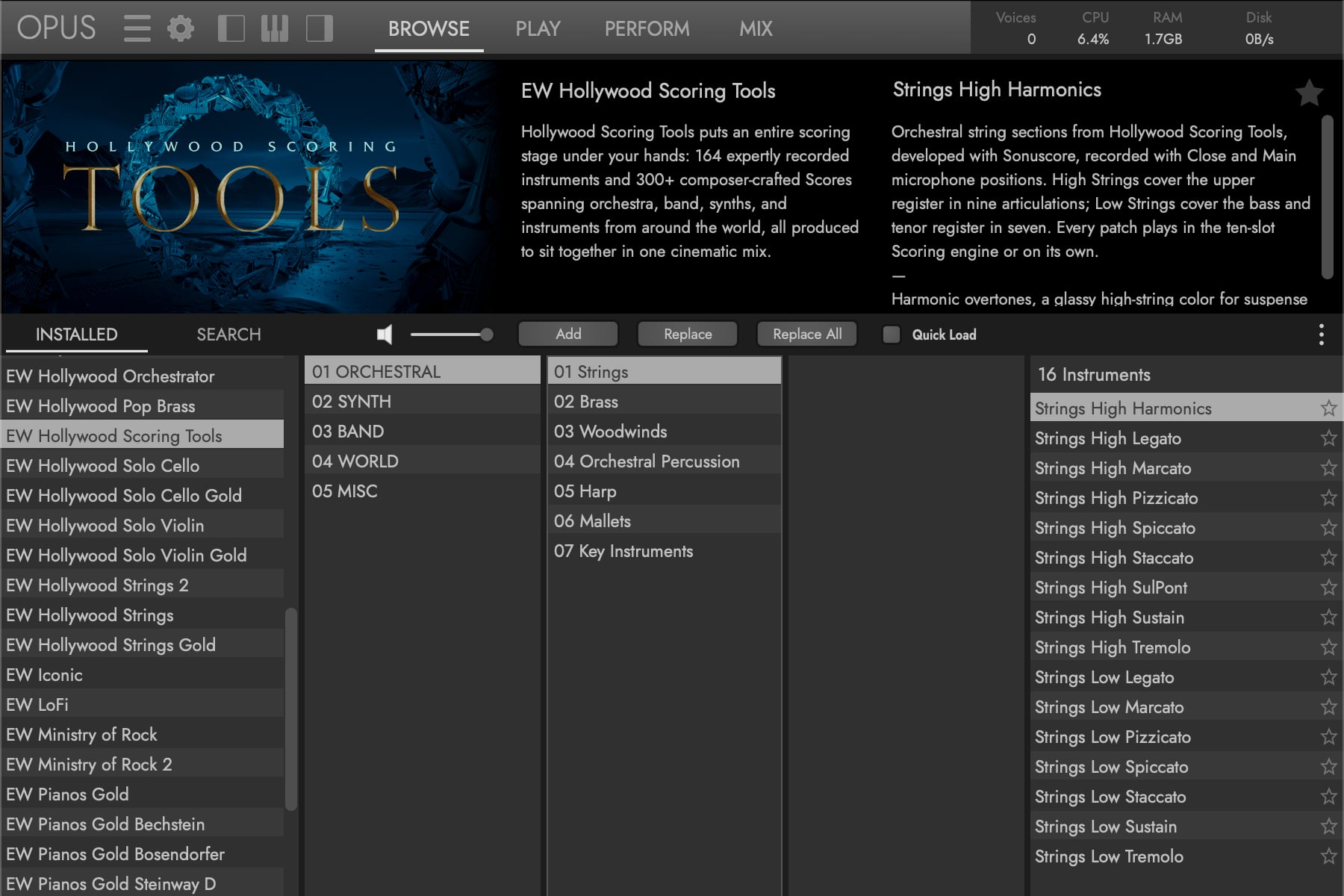
The 164 instruments are also available individually, organized into Categories that each contain Sub-Categories. Orchestral ▸ Strings is shown here, with its sixteen articulations populating the Results List. Load an instrument on its own and it opens on the Opus Play page.
-
Orchestral (57 instruments): The foundation of any score. A complete orchestral palette featuring multiple articulations per section, from sweeping legato strings to punchy brass marcatos, delicate woodwind sustains to thundering timpani rolls. Sections: Strings (16), Brass (14), Woodwinds (8), Orchestral Percussion (10), Mallets (5), Keys (3), and Harp (1).
-
Synth (43 instruments): Modern, cinematic, and otherworldly. From soaring leads and deep basses to atmospheric pads and textural ambiences, purpose-built for hybrid scoring and electronic production. Sections: Pads (11), Hits (10), Basses (10), Leads (8), and Ambience FX (4).
-
Band (20 instruments): A full contemporary band setup with real character. Electric and acoustic guitars, bass, drums, and keys, recorded with the grit and authenticity that modern productions demand. Sections: Drums (8), Guitar (5), Bass (4), and Keys (3).
-
World (34 instruments): Instruments from across the globe, bringing authentic cultural textures to your scores. Plucked strings, bowed instruments, metallophones, wind instruments, and world percussion, each recorded with care for their unique tonal character. Sections: Plucked Instruments (16), Percussion (7), Bowed Instruments (5), Metallophones (3), and Wind Instruments (3).
-
Misc (10 instruments): Choirs, cinematic percussion, trailer impacts, and body percussion, the finishing touches that complete your score and add visceral impact. Sections: Percussion (8) and Choir (2).
CONTINUE READING | SECTION 2.1.1 INSTRUMENT CATEGORIES for a complete listing of every instrument organized by category.
B Reading an Instrument’s Description
Selecting an instrument from the Results List fills the Opus Description Box with two descriptions: one for its sub-category (Strings, Brass, Leads, Pads and so on), one for its articulation (Staccato, Legato and so on). Together they tell you the part it is meant to play in an arrangement.

C How the Instruments Are Sampled
Depth of sampling is what keeps a ten-slot arrangement from sounding mechanical when every slot is repeating a pattern.
- Round robins on short articulations. Repeated notes alternate between separately recorded takes rather than retriggering one sample, so a sixteenth-note spiccato line does not machine-gun.
- Release samples. Sustained articulations carry a recorded release, so notes end with the instrument’s own decay instead of an envelope.
- Mod-wheel dynamic layers. The mod wheel changes tone, not just level, by crossfading between separately recorded dynamic levels.
- True legato. The Legato instruments include recorded slur transitions between notes rather than synthesising the join.
PLEASE NOTE: This depth is why a Score with all ten slots active sounds like an ensemble playing together rather than one pattern layered ten times. It is also why the library is large on disk. See SECTION 1.1.3 WHAT’S INCLUDED.